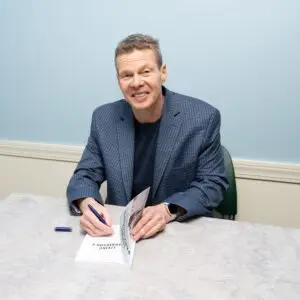
 After receiving his diagnosis, it took two days for Steve to ‘Google’ the life expectancy of someone who lives with Young-Onset Parkinson’s, and two years to begin to proactively address his diagnosis, which he received in 2019 at the age of 55. As someone who was already focused on staying in shape and eating healthy pre-diagnosis, he continued living life as usual, that is until his doctor suggested it was time to consider taking Parkinson’s medication.
“I think it was almost a defence mechanism that I kind of compartmentalised my diagnosis,” said Steve, “But that’s when I really decided that I was going to break this whole problem down and figure out what to do.”
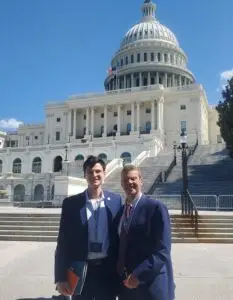
Leaning into his analytical background, Steve began researching Parkinson’s more seriously and taking part in numerous Parkinson’s research studies to further his understanding of the condition and connect with medical professionals. He then went on to attend Parkinson’s Policy Forums in Washington, D.C. and collaborate with other advocates across the United States of America.
Steve also began to push the limitations of his body, training for and completing numerous physically challenging competitions, including 10 Spartan Races, 7 Sprint Triathlons, and more. Reflecting on his achievements and where his internal drive comes from, Steve first acknowledged that everyone’s capabilities and limits are different when it comes to living with Parkinson’s, maintaining that ‘Your goals, are YOUR goals.’
But searching introspectively, Steve boiled his self-motivation down to a concept called ‘self-efficacy’, which refers to an individual’s belief in their capacity to execute behaviours necessary to produce specific performance outcomes. It’s the confidence in one’s ability to influence control over one’s environment.
“If you break it down and simplify it, it’s really a person’s belief to take control of their situation,” said Steve, “And I think I’ve had quite a lot of that naturally.”
One method that Steve suggests to help enhance your self-efficacy, is to focus on short-term goals and accomplishments.
“Instead of thinking about exercising for the next 10 years, I’m thinking about my next Spartan Race or my next triathlon. And then when I finish it, I get this dose of energy to go and do the next one.”
Steve also mentioned that he applies this concept to all areas of his life, not only to his physical well-being.
“I’ve always been the kind of person that if I saw this 20-year track, it’s hard for me to feel motivated, but when I see the finish line, I can sprint for it, rest, get up, and try again the next day. And I look at my advocacy work in the same way. Like when I was trying to get different senators to commit to sponsoring a bill—when I got one, I thought oh man, I am ready to do more. It was like throwing another log on the fire.”
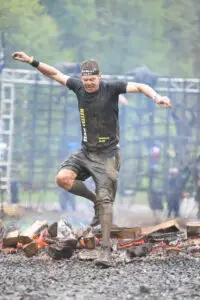
Recounting the moment he had completed last year’s Spartan Race, Steve said that he was covered in rain and mud, struggling to change his clothes, when his wife asked if he felt any regrets. Though it took him an extra hour to cross the finish line, Steve found the joy in sourcing his motivation, challenging his mind and body, and digging deep for his resilience—stating that he couldn’t wait to do the next one.
“To me, what self-efficacy is really about, is setting goals that let you push yourself just hard enough to feel good once you finish… What I do, or what anybody else does, has absolutely nothing whatsoever to do with what YOU do… If walking a lap around the track without assistance or running a 5km is your goal and you can do it safely, that’s really what matters. It’s just setting the right goal for yourself.”
Determined to face his Young Onset Parkinson’s with action, curiosity, and intention, Steve began publishing newsletters called ‘Team Yellen’ as a way to keep his friends and loved ones informed and updated. This is when a friend of Steve’s—also a professional author—reached out and asked if he had ever considered writing a book. Many discussions later, Steve realised that the problem-solver in him had already methodically broken down his approach to living well with Parkinson’s into seven core strategies:
- Building the attitude that fuels resilience
- Gaining the knowledge to make informed decisions
- Assembling a strong support team
- Using exercise as a tool in the fight to slow progression
- Strengthening overall wellness
- Elevating your voice through advocacy
- Advancing science by participating in research.
These strategies make up the main pillars of the practical guide that Steve published in February of 2026 titled, ‘Living Parkinson’s’.
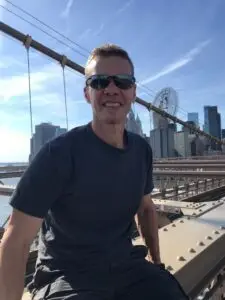
Grounded in solid research and real-life experience, ‘Living Parkinson’s’ is not just a book filled with personal stories, expert insights, and practical tools that can be adapted to create a plan for living well with Parkinson’s, it is an insightful reflection of Steve’s tenacity and his humanity for his fellow community members living with Parkinson’s.
The book was not written as a ‘one-size-fits-all’ prescription, but rather it’s a collection of tools and approaches, mixed with personal reports of lived experience, that Steve hopes will inspire readers to take control, find purpose, and face Parkinson’s head-on.
“Whether you’ve just been diagnosed or you’re 10 years into your journey, I hope you’ll find several of the ‘What you can do today’ action items in the book that you can immediately use to improve your journey. That was my goal in writing ‘Living Parkinson’s’.”
Fight Parkinson’s would like to thank Steve for his generosity of time given to speaking with our team here in Australia. We’d also like to acknowledge all of his continued Parkinson’s advocacy work and congratulate him on the successful publication of his book.
Visit www.livingparkinsons.com to learn more about Steve and his book, ‘Living Parkinson’s’.