This Speech Pathology Week, Fight Parkinson’s unmasks the truth behind hypomimia and highlights the important role of speech pathologists in helping people with Parkinson’s to manage hypomimia and other communication-related symptoms.

What is hypomimia?
Hypomimia is a loss or reduction of facial expressiveness, including emotional expressions. It is a common symptom of Parkinson’s and is characterised by slower and less pronounced facial movements, including smiling, frowning, blinking, raising eyebrows, etc. The result can be a face that looks flat and emotionless and can make it difficult to communicate effectively.
The term ‘masked face’ was first used by Jean‐Martin Charcot in 1860, describing Parkinson’s facial expressions. In the following decades, the reduction in facial movements was included in the classical characteristics of people with Parkinson’s.
William Gowers, in his manual of diseases of the nervous system, described the typical facial expression of people with Parkinson’s as “anxious and fixed, unchanged by any play of emotion”. The term ‘amimia’ was then used by Samuel Alexander Kinnier Wilson, and ‘hypomimia’ was introduced in the following decades.
How severity is measured
Quantifying, or measuring hypomimia severity has been addressed through different approaches over the years and clinical evaluation of hypomimia is rather challenging. The most frequently utilised rating scale to globally assess the severity of Parkinson’s, and which is noted in most published studies is the Unified Parkinson’s Disease Rating Scale (UPDRS), shown below.
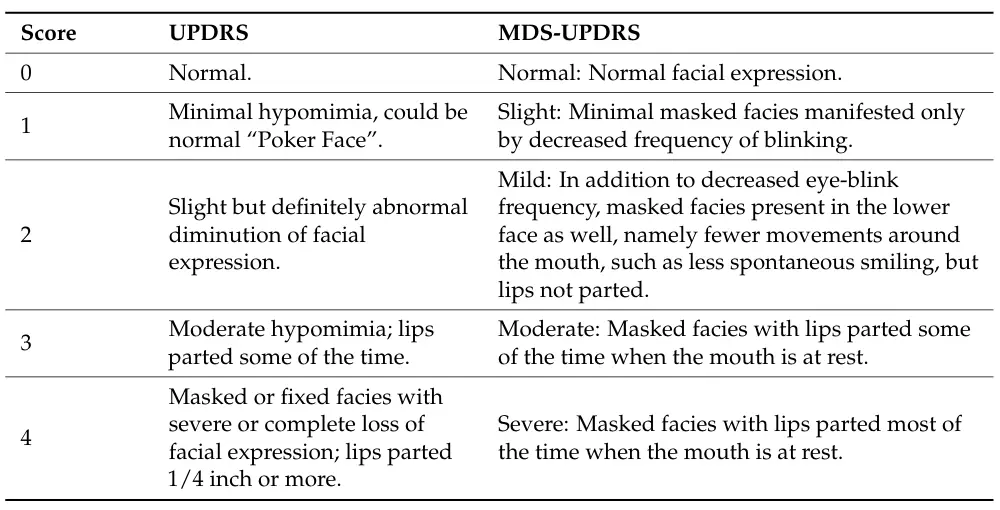
While the UPDRS can help to track progression over time and gauge how well treatments may or may not be working, it is important to note that this assessment tool suffers from subjective evaluation by the assessor. Moreover, the limited five-point scale may not be sensitive enough to detect subtle changes in patients’ conditions.
What causes hypomimia?
In Parkinson’s, nerve cells that produce dopamine gradually die off. Dopamine is the chemical messenger that helps coordinate smooth, purposeful movement throughout the body, including in the small muscles of the face.
As dopamine levels fall, the signals that tell facial muscles to contract, relax, and shift in subtle patterns become smaller and less precise.
The result is the same stiffness and slowness that causes a shuffling walk or a quiet voice, just applied to the 40-plus muscles responsible for facial expression.
Other non-motor symptoms may also impact on facial expression, such as mood.
How hypomimia can impact daily life
Facial movements are crucial for social and emotional interaction and wellbeing. Hypomimia, combined with Parkinson’s speech changes, such as low voice volume, can make it difficult for people with Parkinson’s to communicate effectively with others.
When the conversation lacks the emotional cues that facial expression provides, those attempting to engage in the conversation can often assume that the person with Parkinson’s is uninterested, disengaged, depressed, or even cognitively impaired.
Fight Parkinson’s acknowledges the frustrations that these misinterpretations can cause, and that if not addressed, this impaired level of communication can lead to isolation for the person with Parkinson’s, which is detrimental, because social interaction is integral for mental health and quality of life.
Withdrawing from social situations can be one of several elements that can lead to depression. If you are experiencing symptoms of depression, help is available. Talk to your doctor or contact Fight Parkinson’s for support. Mood changes are common in Parkinson’s, and treatable.
Research also suggests that people with Parkinson’s who do not express emotion on their faces, also have an impaired ability to recognise emotion in others.
This is because we understand others’ actions and emotions by internally “simulating” their movements. If our own facial movements are reduced, this may affect the ability to simulate and interpret others’ facial expressions.
Managing hypomimia
For those who are experiencing hypomimia, there are many ways to maintain healthy social connections, including strategies to help convey your emotions, without utilising facial expressions. There are also several treatment options that can help you to improve your facial masking, including medication and speech therapy.
Medication
Because hypomimia shares its underlying cause with other Parkinson’s motor symptoms, the standard dopamine-replacing medications used for Parkinson’s can improve facial expressiveness to some degree. When medication is effective for tremor and stiffness, it often helps the face as well, though hypomimia tends to be less responsive to medication than limb symptoms.
Speak to your GP or specialist about Parkinson’s medication, and learn more here.
Useful tips
- If you notice any changes to facial expression, communication, or swallowing, consider working with a speech pathologist who can provide education, strategies, and therapy. There may also be exercises that can assist
- Openly discuss any changes with family and friends and seek feedback and support
- Practice saying how you are feeling rather than relying on non-verbal cues
- Prioritise social connection. It is not only crucial for wellbeing but also a great ‘exercise’ that you can do for your muscles and brain. If talking with friends or family is feeling more tiring, consider how you can ensure it is manageable and enjoyable. This may involve changing the timing, the environment, or the number of people
- Accept limitations. Some days your face just won’t cooperate, especially if you’re tired or your medications haven’t kicked in. Learn not to beat yourself up and to rest when needed.
Support for you
If you are searching for advice, support, or would like assistance finding a local speech pathologist, please contact Fight Parkinson’s:
- Call the Fight Parkinson’s Health Team on 1800 931 031
- Email [email protected]
- Speak to your doctor, health nurse, or specialist.