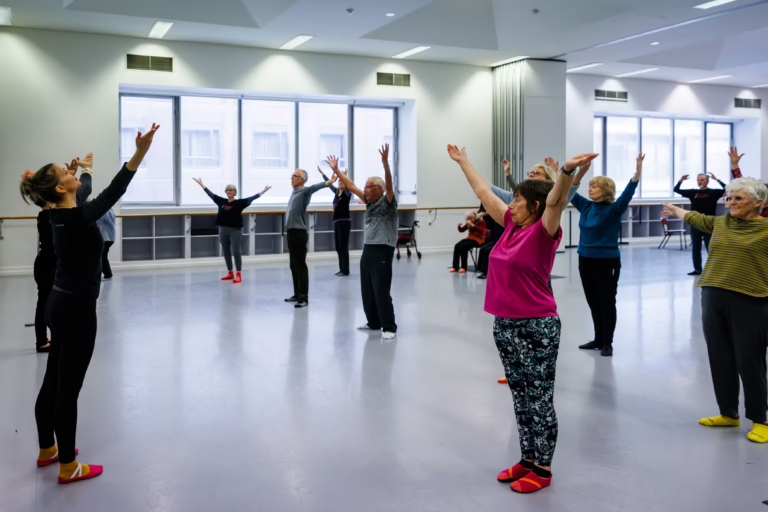
Stigma around Parkinson’s often begins with misunderstanding. Stereotypes ignore the reality that people with Parkinson’s, from all backgrounds, live with. Visible symptoms like tremors, freezing of gait or speech issues can be misread as intoxication or aging, rather than signs of a complex neurological condition. These reactions can be hurtful and isolating.
About the research
At the 2026 Fight Parkinson’s Research Symposium, Dr Sarah Davies, Lecturer in Occupational Therapy, School of Health, University of the Sunshine Coast (UniSC) and team were awarded the Clinical Seed Grant, under Fight Parkinson’s Seed Funding Grants Program.
The Clinical Seed Grant was awarded for Dr Davies’ project, ‘Mapping Real-World Stigma to Support Victorians with Parkinson’s’.
By utilising the Smartphone Ecological Momentary Assessment (SEMA3, University of Melbourne) app, the research team aims to capture experiences of Parkinson’s stigma in real-time. By moving beyond “after-the-fact” questionnaires, participants report stigma moments exactly as they occur, providing high-resolution data on environmental and social triggers.
This understanding is essential for developing effective ways to reduce the impact, promote social inclusion and participation and to improve quality of life for people with Parkinson’s.
Who can participate?
You may be eligible to participate in this study if you are:
- 18 years or older
- Have been diagnosed with Parkinson’s
- Own a smartphone with internet/data and know how to use it.
What does participation involve?
If deemed eligible, participants will be required to complete the following:
- A 90 minute in-person or online assessment
- Setting up the survey app on your phone
- 4 short surveys per day, for 7 days (this may take up to 90 minutes total)
- A 60-minute focus group discussion following the survey period.
Risks and benefits
There are no anticipated physical risks associated with your participation. Sometimes thinking about the themes discussed in the surveys and focus groups can create uncomfortable or distressing feelings. You are not required to answer any questions you don’t want to and you may discontinue or pause the surveys at any time if required.
If you need to talk to someone, you may wish to contact family or friends, your General Practitioner, or Beyond Blue (1300 224 636). Fight Parkinson’s also provides a range of support services available to people with Parkinson’s (1800 931 031).
Additionally, repeatedly answering surveys over multiple hours and days may become burdensome. To mitigate this, surveys include multiple choice questions which take only 3 minutes to complete and will be capped at 4 surveys per day for 7 days. Surveys can also be snoozed and completed at later times if you are unable to complete them immediately, such as when you are driving or in the middle of an important activity.
It is not anticipated that this research project will directly benefit you, but we appreciate your input as a contribution to the discipline. Your contribution will assist with understanding how adults with Parkinson’s experience stigma and future progress to addressing these issues.
Important notes
- Participation is completely voluntary and you may withdraw from the study at any time
- If you decide to take part and later change your mind, you are free to withdraw at any time
- Your participation, or not, will not affect your relationship with UniSC, UniMelb, Fight Parkinson’s or members of the research team
- You will be asked to consent to the use of your data and information to be collected, stored and used in analysis and publications in a non-identifiable format
- Participants will receive a $50 electronic gift voucher at the completion of the Ecological Momentary Analysis survey period, regardless of the rate of daily survey completion or attendance at focus groups.
Interested in taking part?
If you meet the above criteria and would like to express your interest in participating, please click the button below and complete the online registration form.
This website also contains information about:
- The types of questions you may be asked in the surveys
- Privacy, confidentiality and results
- Who to contact if you have any concerns or complaints.
Alternatively, please download the flyer that is available on this page, under ‘Related resources for you’ and scan the QR code at the bottom right-hand corner of the document.
If you would like to learn more, you can also contact the Research Coordinator directly:
Dr Libby Proud
Phone: (03) 8344 3920
Email: [email protected]