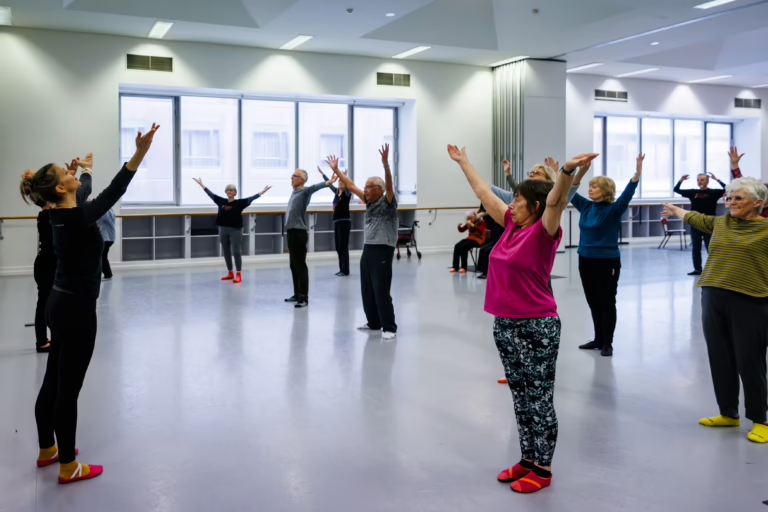

This World Mindfulness Day 2026, Fight Parkinson’s explores the key areas of self-care and offers tips on how to implement small changes in your everyday life to care for yourself.
What is self-care?
According to the World Health Organisation (WHO), ‘self-care’ is defined as “the ability of individuals, families, and communities to promote health, prevent disease, and maintain health and to cope with illness and disability with or without the support of a health-care provider.”
Simply explained, self-care is an empowering concept that includes taking the time to tend to your own needs. In relation to Parkinson’s (including Young Onset) and Atypical Parkinson’s (including CBS, MSA, and PSP), self-care refers to the actions and choices you can make at home to complement the care provided by your healthcare team.
Based on a survey of 5,000 patients regarding stress and mindfulness, referenced in NPJ Parkinson’s Disease, mindfulness-based practices helped participants better cope with stress related to living with Parkinson’s and led to a reduction in anxiety and depression. Improved cognitive and motor function, decreased “off episodes” and even a decrease in tremors (which have been found to worsen with stress) were also reported in Parkinson’s patients after participating in mindfulness practices.
Self-care looks different to everyone, and can range from practical habits to support mental and physical health, mood-boosting activities, to complementary therapies, like yoga.
Please note: Parkinson’s self-care should aim to support, not replace, any medical care from healthcare professionals.
Self-care for people who live with Parkinson’s
An article published by Parkinson’s Europe in April 2026 states that there are three key areas of self-care that people with Parkinson’s can focus on to look after themselves in ways that supports and complements their healthcare plan: mind, movement, and nutrition and gut health.
Mind

Whether it’s starting the morning with a cup of tea, taking a daily stroll through the park, or reading a chapter of your book, these small rituals can be attributed to the word: mindfulness.
Defined by Greater Good magazine—a science-based publication by the Greater Good Science Centre at the University of California, Berkeley—’mindfulness’ means maintaining a moment-by-moment awareness of our thoughts, feelings, bodily sensations, and surrounding environment, through a gentle, nurturing lens.
With roots in Buddhist meditation, the concept of mindfulness also involves paying attention to our present thoughts and feelings with acceptance, rather than judgement.
According to a survey of 5,000 patients regarding stress and mindfulness, referenced in NPJ Parkinson’s Disease, mindfulness-based practices helped participants better cope with stress related to living with Parkinson’s and led to a reduction in anxiety and depression. Improved cognitive and motor function, decreased “off episodes” and even a decrease in tremors (which have been found to worsen with stress) were also reported in Parkinson’s patients after participating in mindfulness practices.
While scientists don’t yet have a complete answer to what is behind these benefits, they believe that the practice of mindfulness has the effect of changing the structure of the brain itself. Increases in grey matter density in an area of the brain— thought to play an important role in the motor symptoms of Parkinson’s—were found with MRI imaging of the brains of people with Parkinson’s who participated in a mindful meditation program, according to a study published back in 2013 in Clinical Neurology and Neurosurgery.
“Mindfulness is an increasingly popular approach for supporting emotional wellbeing, and can be particularly beneficial for people living with Parkinson’s. Rather than trying to push thoughts or feelings away, mindfulness teaches us to meet our inner experience with curiosity and kindness.” – Dr Angeliki Bogosian, School of Health and Medical Sciences, University of London, UK
Ways to add more mindfulness into your life
- If you find yourself rushing, make an effort to slow down
- Try a breathing technique when you need a moment of calm
- Choose to spend less time looking at screens today
- Use words of kindness with yourself and others
- Try something new and see what you notice and how you feel
- Pause and listen to some music you enjoy
- Notice 3 things you find beautiful in the outside world.
Please note: Mindfulness is a distinct process and only one component of self-care. You can still practice self-care in other forms that are most suitable for you and your lifestyle. Read on to learn how movement and nutrition can contribute to your self-care.
Movement

In Parkinson’s, there are reduced levels of dopamine in the brain, which is heavily involved in controlling the movement of your body. For this reason, the most obvious changes related to Parkinson’s are normally those that affect your movement. In particular, slowed movement, stiff muscles, and changes to posture affect all people with Parkinson’s. These issues and others can lead to challenges with walking, freezing, and falling.
“For many people living with Parkinson’s, one of the most frustrating changes is how movement can suddenly feel harder to start or control. They often face challenges with initiating movement, as well as maintaining movement amplitude, speed, and rhythm, due to the loss of automatic motor control.” – Josefa Domingos, Physiotherapist (and President of Parkinson’s Europe), Portugal
Walking
‘Gait’ is used to describe your walking pattern or how you walk and is often impaired in people with Parkinson’s. The most common changes include:
Slowed movement
- Small and/or shuffling steps
- Freezing
- Little or no swinging of one or both arms
- Tendency to lean forward.
It’s also common for people with Parkinson’s to become easily tired during walking, even after short distances. These changes are likely to become more prominent as Parkinson’s progresses. However, the way these symptoms appear will be different for everyone.
Changes to walking can also be related to the medication cycle. For example, walking can change as a result of the ‘on/off’ cycles of Parkinson’s medications.
Ways to manage changes to your gait
- Regularly review medications with your GP or specialist
- Physiotherapists are considered to be the experts in helping with problems related to walking and can provide a personalised assessment and treatment program.
Freezing
According to research, freezing is a symptom that is increasingly being considered as a mixed motor and non-motor symptom. It usually occurs when the person with Parkinson’s, particularly those who have had Parkinson’s for some time, notices they are experiencing difficulties with multi or dual tasking.
The freeze is triggered when external stimulus, e.g. walking through a doorway, approaching a chair, etc, causes the feet to stick to the floor. It’s normally only temporary, and once past that position, the person can often start walking freely again. Although it’s only temporary, freezing can be hazardous due to the increased possibility of falling.
Freezing doesn’t only happen during walking. People with Parkinson’s also report episodes of freezing during other repetitive activities such as brushing their teeth or writing. Freezing can also affect your speech when you’re attempting to talk to someone.
If you have noticed problems with freezing, consider seeking an occupational therapy and/or physiotherapy referral. Both of these healthcare professions are able to teach strategies to help overcome episodes of freezing.
Please note: A strategy that works for one person, may not be suitable for another. Always consider speaking with your healthcare team to safely determine what works best for you.
Ways to avoid freezing episodes
- Always take your medications on time
- Walk to a rhythm (listening to a beat or music can help)
- Avoid distractions when you’re walking, just focus on long steps.
Ways to overcome an episode of freezing
- Prompt yourself by saying aloud ‘left, right, left, right’ or ‘one, two, one, two’ or ‘one, two, three, step’
- Stand still and start swinging your arms
- Start shifting your weight from foot to foot
- Visualise an imaginary line to step over.
Falling
Gait problems can make people with Parkinson’s more likely to fall. Some of the more common causes of falling for people with Parkinson’s include:
- Freezing
- Short and/or shuffling steps
- Tendency to lean forward
- Reduced blood pressure
- Environmental hazards.
Each of these problems can interfere with a person’s balance, resulting in a fall.
Falls are more likely to happen and cause serious injury in the later stages of Parkinson’s. Be aware that falls can occur at any stage of Parkinson’s.
Falling is particularly hazardous because of the risk of serious injury and are a common cause of hospital admission for people with Parkinson’s. Whilst minor cuts and bruises are common, more serious injuries can occur, and make the challenge of living with Parkinson’s more difficult.
If you have had a fall recently, you should advise your GP and specialist, particularly if falls are becoming more frequent. Adjusting medications can be helpful in some situations. Assessment and treatment by a physiotherapist and/or occupational therapist is also recommended. They can offer advice and strategies to help prevent falls.
Ways to lower your risk of falls in Parkinson’s
- See a physiotherapist regularly
- Always take medications on time
- Undertake regular exercise to help with balance and leg strength
- Walk to a rhythm (listening to a beat or music can help)
- Focus on long steps when you’re walking
- Remove hazards in your home, such as mats, rugs, or furniture that blocks walkways.
Nutrition and Gut Health

A healthy and well-balanced diet is encouraged for people with Parkinson’s to ensure daily energy and nutrient requirements are met.
Parkinson’s affects individuals differently and varies according to how long a person has had the condition, response to treatment, side effects to medications, and other pre-existing health issues.
The nutritional issues faced by people with Parkinson’s are complex and diverse, and therefore need to be reviewed by an accredited practising dietician on a case-by-case basis.
Given that Parkinson’s is a progressive neurological condition, nutrient requirements may change through the journey with the condition.
Consuming a well-balanced diet means eating a variety of foods from all the food groups, including whole grains, breads, cereals, fruits and vegetables, meat, legumes, and dairy products. The Mediterranean diet is identified as being an ideal diet to follow for people with Parkinson’s.
Ways to maintain a healthy and well-balanced diet
- Eat a variety of fresh fruits and vegetables, including brightly coloured, fresh, in-season produce
- Aim for 2 serves of fruit (150g or 1 medium size piece of fruit, 1 cup canned fruit or 2 small plums/apricots) and 5 serves of vegetables per day (75g or ½ cup cooked green or orange vegetables, ½ cup sweet corn, ½ medium potato or starchy veg)
- Aim to consume 25-30g fibre per day, along with 1.5-2L[VM2] of water per day – this can help with managing constipation and staying regular
- Establish regular eating patterns, consisting of three main meals and snacks throughout the day
- Don’t skip breakfast
- Try to include a variety of food from at least three different food groups for each meal. A fun idea is to try and display as many colourful foods on your plate by incorporating a serving of fruit or vegetables, grains, dairy, and meat or legumes
- Limit your intake of alcohol (<2 standard drinks/day), soft drinks, carbonated drinks, cordials, and juices
- Try to limit your ‘sometimes’ foods that are higher in kilojoules, saturated fats, added salt and added sugar. For example, pastry and bakery products, processed meats and sausages, ice-cream, confectionary, cream, butter, soft drinks, energy drinks, and takeaway deep-fried food.
“If I were to choose one or two nutrition habits for people living with Parkinson’s to include in their daily self-care, they would be staying well hydrated and eating enough fibre.” – Kinga Topolowska, Highly Specialist Neurosciences Dietitian at the National Hospital for Neurology and Neurosurgery, London.
For people living with Parkinson’s, there is a lot to consider, and which affects your nutrition, including unintentional weight loss, managing medication and meals, the role of protein, swallowing difficulties, constipation, and more. But you are not alone.
Visit Parkinson’s & Eating Well: Nutrition, Managing Symptoms & Weight Loss | Fight Parkinson’s to learn more or contact Fight Parkinson’s for support.
Self-care for carers

As Parkinson’s progresses, symptoms will change over time, as will the role of the carer. From assisting with medications, to providing emotional support, and helping with everyday activities, like showering, eating, and toileting, the role of a carer can be very busy and demanding at times.
Looking after yourself is important. By recognising your own needs, you’ll be better equipped to balance caring for someone with the rest of your life and to be able to provide the best care possible.
Kira is a young Fight Parkinson’s Community Member who lives with and cares for her dad, who lives with Parkinson’s, and summed up what self-care looks like to her.
“Still being in my 20s, self-care for me looks like quiet time out in nature—sometimes even just the backyard—exercising, speaking to family for support, but most importantly, remaining present and mindful! Cherishing my time with my dad, making memories, taking it day by day.”
Ways for carers to practice self-care
- Focus on the essentials for well-being – try to get enough sleep, eat well, and get some exercise wherever possible. Exploring relaxation tips and techniques and taking time out to recharge are also extremely important
- Sustain a healthy lifestyle – how well you fuel and care for your body will impact your capacity to provide care on an ongoing basis. Make healthy food choices wherever possible, keep hydrated, and look for opportunities to add exercise into your everyday activities
- Manage stress – learning about the condition and developing your understanding of how it progresses can be incredibly empowering and should not be underestimated. It also helps to accept what you can’t change, focus on what you can do to help, and take pride in the things you do well
- Get support – Stress can also be alleviated through accessing the support you need from family and friends, in your community, or with a counsellor. It’s also important to reach out for help when (or before) you need it
- Access respite care – It can be very difficult to sustain the demands of caring without taking regular breaks, and having a break can be good for you both. This is called ‘respite care’ and a range of options are available depending on your location and situation. For more information about respite services in your area, call the Commonwealth Respite and Carelink Centre on 1800 052 222.
For more information on support for carers and loved ones, including counselling and community support, and government financial support, please visit Support for Carers | Living with Parkinson’s and Atypical Parkinson’s or contact Fight Parkinson’s.
Phone: Free call 1800 931 031 – A free translation service is available on this line.
Email: [email protected]